And why the capacity for self-reflection matters more than most people assume

„Good judgement requires that you understand yourself as part of the judgement.“
Critical thinking is often described as a skill. As something you either have or you don't. As a cognitive technique you can deploy when needed.
I consider that too narrow a description. And after several years of research on this topic, I am convinced that this reduction rests on a fundamental misunderstanding of how people actually judge.
A Concept Without Clear Contours
Most people cannot describe what critical thinking is. Even in contexts where the concept explicitly plays a role, the idea of it tends to remain diffuse. When it does become tangible, it usually appears as scepticism or as a call to question things, without any clarity about what exactly should be questioned, or how.
When people think about critical thinking, they tend to think about checking arguments, evaluating sources and identifying logical errors. All of that is correct, but it only captures half of what actually happens when we judge.
Cognitive science research over the past few decades has shown that human thinking does not operate on a single level. Kahneman and Tversky described two parallel systems: a fast, intuitive-affective System 1 that runs in the background and evaluates constantly, and a slow, conscious and rational System 2 that only becomes active when we assess a situation as complex or important enough to warrant deliberate attention.
The important word here is assess. Because even that assessment originates first in the fast system.
Intuition is nothing mystical. It can be understood as an accumulation of cues stored in the unconscious, which serve as the basis for rapid responses in similar situations. Nobel laureate Herbert Simon put it plainly: intuition is, at its core, recognition.
The affective level precedes rational thinking in evolutionary terms. It filters, weighs and evaluates before conscious thought even begins. This means that emotions, norms, values and personal conditioning exert unconscious influence on decision-making processes. They can lead to the rational check never taking place at all, because the situation already feels resolved.
This does not mean we cannot trust our thinking. It is simply the basic structure of human cognition, and one we need to learn to work with.
What This Means for a Definition of Critical Thinking
Those who reduce critical thinking to the rational examination of arguments and facts are ignoring precisely this mechanism. In my research, I developed a definition that does not separate cognitive and affective aspects but brings them into a systemic relationship through self-reflection.
"Critical thinking (CT) refers to the careful, systematic and, above all, reasoned decision making that occurs when the thinker engages with an object or subject. It involves the evaluation and application of one's own knowledge and skills at the cognitive level, and the self-reflective consideration of one's own emotions, values, attitudes, and motivations at the affective level. It also facilitates constant self-regulation and adaptation, which brings the thinker back to him/herself and places him/her not only in the position of the evaluator, but also in the position of the person being evaluated." (Albrecht, 2025)
For me, that last sentence is the most important one.
The Dual-Process Model of Critical Thinking
On the basis of this definition, I developed the Dual-Process Model of Critical Thinking (DP-CT). It describes critical thinking as a positioning process in which cognitive and affective factors govern the perception and processing of information.
The intuitive, affective system precedes the rational one. It continuously generates impressions, intuitions and emotional reactions that are frequently adopted as a basis for decisions without being examined. Self-reflection as perception and self-regulation as adaptation function in this model as a mediating component between both levels. They make internal and external influencing factors visible, bring them into conscious awareness and thereby create the very possibility of incorporating them into the process of judgement.
Without this feedback loop, critical thinking risks functioning in only one direction. It remains outward-facing, directed at arguments and sources, but blind to the personal conditioning that has already shaped the judgement.
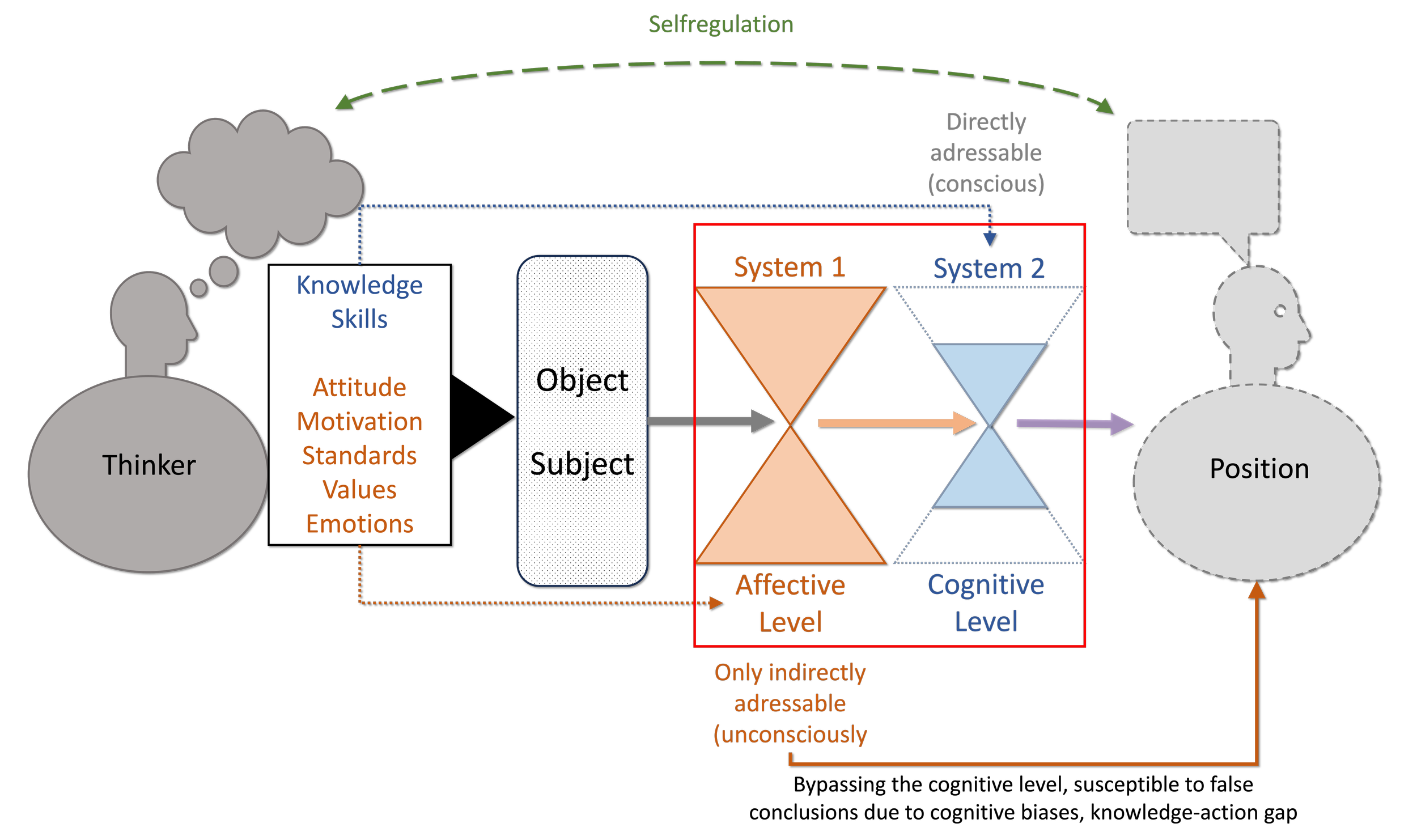
Dual-Process Model of Critical Thinking (DP-CT) (Albrecht, 2025), an extension of the synergy model of critical thinking by Rafolt et al. (2019)
The Triadic Model: Three Components That Condition Each Other
The Triadic Model of Critical Thinking is a model I developed in the course of my research. It describes three components that do not function independently for good judgement but condition one another.
The first component is declarative knowledge. This does not mean factual knowledge for its own sake, but knowledge as a basis for evaluation and as connective knowledge. Someone who knows nothing about a subject cannot take a reasoned position. But knowledge alone is not enough. It provides the substantive foundation yet says nothing about where the information comes from, how reliable it is or what context shaped it.
This is precisely where the second component comes in: epistemological understanding. It describes the capacity to assess information and sources, to evaluate the methodology behind them, to acknowledge their provisional nature and to consider the conditions under which they were produced. Who collected this data, with what interest, at what point in time, by what means and what does it actually claim? Epistemological understanding is therefore not an academic add-on but the prerequisite for being able to situate knowledge at all.
The third component is self-reflection. And in my view, it is the most consistently underestimated of the three. Self-reflection in the context of this model does not mean self-criticism or rumination. It is a deliberate introspective process, which includes the perception, weighting and evaluation of the internal and external factors that accompany one's own judgement. Which values, experiences and conditionings are shaping my perception of this situation right now? Which social norms or emotional reactions are at play? These questions have a direction and can make visible what would otherwise remain unconscious.
Declarative knowledge and epistemological understanding are necessary but not sufficient conditions for good judgement. Only when supplemented by self-reflection can hasty conclusions be reconsidered, existing views questioned and personal conditioning brought into the evaluation process.
Critical thinking is therefore not a tool deployed on demand. It is a systemic practice of thought that requires the interplay of all three components and creates from that interplay a multi-perspectival space of possibility.
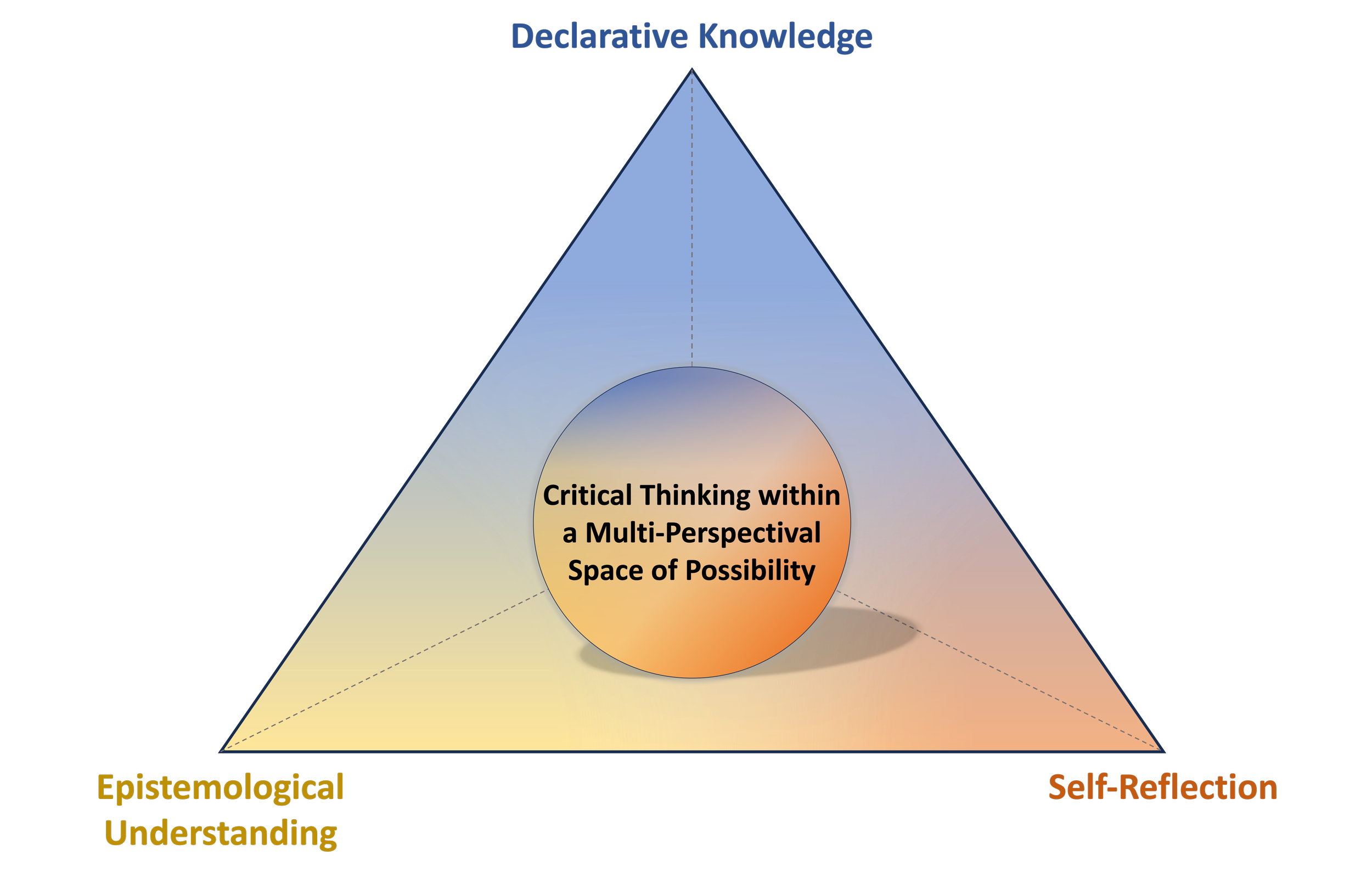
Triadic Model of Critical Thinking (Albrecht, 2025)
A Conviction That Runs Through My Work
I believe we can only think within the limits in which we are able to ask ourselves questions.
That may sound trivial at first. But it has far-reaching consequences. Perspectives I cannot ask about cannot be considered in decision-making processes. Not because I reject them, but because I simply do not see them. The range of questions that occur to me about a situation is therefore also the range of my thinking in that situation.
Expanding perspectives means expanding the questions one is capable of asking. And that is not an academic exercise but an expansion of the actual possibilities available for assessing and responding to a situation.
Self-Reflection Has a Direction
A distinction is worth drawing here, because the confusion is common.
Self-reflection, as I understand it in this model, is not circling around one's own person. It is not brooding and it is not rumination. Rumination is the repetitive, unproductive reliving of thoughts and feelings that reinforces itself and typically produces no new insight. Research from clinical psychology shows that rumination tends to impede problem-solving rather than support it.
Self-reflection in the context of critical thinking is something different. It is a deliberate introspective process that asks which values, experiences and conditionings are currently influencing one's perception of a given situation and which internal and external factors are bearing on one's own judgement. These questions have a direction and a purpose. They make visible what would otherwise remain invisible and therefore exert influence unnoticed.
I consider reflective introspection a meaningful quality of life. It improves the quality of one's own decisions and sharpens awareness of what colours one's judgement, which makes it effective in interpersonal contexts as well. And it is the prerequisite for shaping one's own space of possibility with intention.
What This Means
Critical thinking is not a checklist and not a technique. It is a fundamental disposition towards one's own thinking.
It requires that you scrutinise your own judgement as rigorously as you scrutinise the argument of someone else. That you acknowledge that emotions and values are not disturbances in the thinking process but constantly present factors that operate either reflectively or unreflectively.
The quality of decisions does not depend solely on how much someone knows. It depends equally on how well someone is able to understand themselves as part of the judgement.
We can only think within the limits in which we are able to ask ourselves questions. Whoever expands those limits expands the space in which they are able to act.
-
Albrecht, L. B. (2025). Kritisches Denken in der Chemielehrer*innenbildung: Eine konzeptionell-empirische Studie zur Integration und Operationalisierung. Logos Verlag Berlin. https://doi.org/10.30819/5970
Elster, J. (1989). The cement of society: A study of social order. Cambridge University Press.
Elster, J. (2008). When Rationality Fails. In J. E. Adler & L. J. Rips, Reasoning: Studies of Human Inference and its Foundations (S. 94–113). Cambridge University Press.
Evans, J. St. B. T. (2008). Dual-Processing Accounts of Reasoning, Judgment, and Social Cognition. Annual Review of Psychology, 59(1), 255–278. https://doi.org/10.1146/annurev.psych.59.103006.093629
Facione, P. A. (1990). Critical Thinking: A Statement of Expert Consensus for Purposes of Educational Assessment and Instruction. Research Findings and Recommendations. American Philosophical Association.
Frankish, K. (2010). Dual‐Process and Dual‐System Theories of Reasoning. Philosophy Compass, 5(10), 914–926. https://doi.org/10.1111/j.1747-9991.2010.00330.x
Grant, A. M., Franklin, J., & Langford, P. (2002). The Self-Reflection and Insight Scale: A New Measure of Private Self-Consciousness. Social Behavior and Personality: an international journal, 30(8), 821–835. https://doi.org/10.2224/sbp.2002.30.8.821
Haidt, J. (2008). The Emotional Dog and Its Rational Tail: A Social Intuitionist Approach to Moral Judgment. In J. E. Adler & L. J. Rips, Reasoning: Studies of Human Inference and its Foundations. Cambridge University Press.
Halpern, D. F. (2014). Thought and knowledge: An introduction to critical thinking (Fifth Edition). Psychology Press.
Kahneman, D. (2012). Thinking, fast and slow (D. T. O’Brien, Übers.). Journal of Social, Evolutionary, and Cultural Psychology, 6(2), 253–256. https://doi.org/10.1037/h0099210
Kuhn, D. (1999). A Developmental Model of Critical Thinking. Educational Researcher, 28(2), 16. https://doi.org/10.2307/1177186
Nolen-Hoeksema, S., Wisco, B. E., & Lyubomirsky, S. (2008). Rethinking Rumination. Perspectives on Psychological Science, 3(5), 400–424. https://doi.org/10.1111/j.1745-6924.2008.00088.x
Paul, R., & Elder, L. (2014). Critical thinking: Tools for taking charge of your learning and your life (Third edition, Pearson new international edition). Pearson Education Limited.
Rafolt, S., Kapelari, S., & Kremer, K. (2019). Kritisches Denken im naturwissenschaftlichen Unterricht – Synergiemodell, Problemlage und Desiderata. Zeitschrift für Didaktik der Naturwissenschaften, 25(1), 63–75. https://doi.org/10.1007/s40573-019-00092-9
Stanovich, K. E., & West, R. F. (2008). On the relative independence of thinking biases and cognitive ability. Journal of Personality and Social Psychology, 94(4), 672–695. https://doi.org/10.1037/0022-3514.94.4.672
Thompson, V. A., Prowse Turner, J. A., & Pennycook, G. (2011). Intuition, reason, and metacognition. Cognitive psychology, 63(3), 107–140. https://doi.org/10.1016/j.cogpsych.2011.06.001
Reflection starts with dialogue.
If you’d like to share a thought or question, you can write to me at contact@lucalbrecht.com
Thinking from Scratch
by Luc Albrecht
Exploring how we think, decide and create clarity