What one search reveals about our convictions
Last week the drive ended on an uncomfortable insight, ease is not truth. This time we go where that confusion weighs heaviest, to our own convictions. And to the question of why being wrong so often feels, from the inside, like being right.
„The first principle is that you must not fool yourself, and you are the easiest person to fool.“
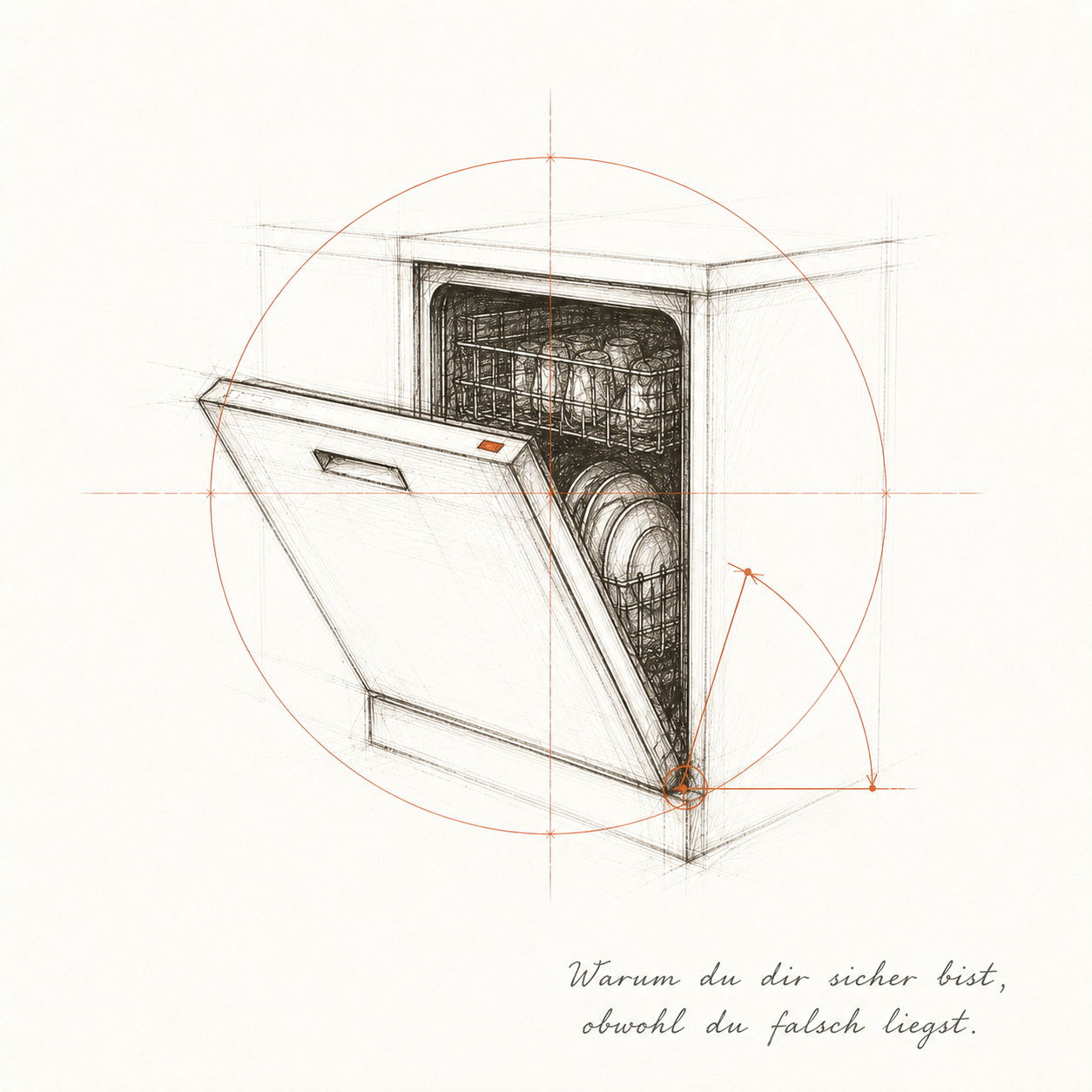
The dishwasher
It has been a while now, but I remember a dinner with a friend. As so often, we get talking about everything under the sun, and we fall into one of those arguments that are too small to win and too big to let go. It is about the dishwasher. He washes up by hand and thinks it more economical. "The thing runs for an hour," he says, "that can't use less than my five minutes at the sink." I, for my part, defend my dishwasher with a conviction that surprises even me. I hear myself quoting figures I have read nowhere, ten litres against forty, picked up somewhere and never checked. The evening draws to a close, and we say goodbye, friendly and undecided.
On the way home I notice that the matter will not let me go. Not because water consumption fascinates me, but because I want to be right. And a layer beneath that lies something more honest. I do not enjoy washing up by hand. I never have, and a world in which the machine is also the thriftier option is a world that suits me very well.
Later that evening I am on my phone, meaning to look the thing up quickly. I open the browser, the search box waits and my fingers type as if by themselves, dishwasher uses less water than washing by hand.
The page loads, and I stop short, because there is no question mark in that query. It already holds the verdict before the first answer appears. I did not want to find out who was right. I wanted to fetch material in order to be right.
So I delete the line and phrase it neutrally, water consumption dishwasher hand washing comparison. For a moment that feels very grown up. Then I watch what my eyes do with the results. The first hit agrees with me and I click it, read approvingly, nod inwardly. The second contradicts me, at least in part, hand washing can be more economical if you wash with discipline in a filled sink rather than under running water. And all at once I am an assessor. Who measured that? Which machine, which year? And who, please, washes up that carefully (I certainly do not, that was the whole starting point)? The objections are all fair. I simply had not raised them at the first hit.
Same data, two standards.
You probably know this move, even if it finds other places in you. We rarely type, is it true that. We type the answer we want and let the web complete it. The same move runs in conversation, when we are already sorting counterarguments while listening instead of hearing what the other person says. It runs in the report, where we welcome the figure that fits our own view and have the one that does not checked three times over. It runs in the feed, which has long been assembled for us so that the contradiction never even arises.
This pattern has a name. Confirmation bias describes our tendency to seek information, read it and remember it in a way that supports what we already believe. The psychologist Raymond Nickerson once tracked it through all its disguises and concluded that hardly any other tilt in our judgement is so widespread. The crucial thing about it is the asymmetry. We are not forging anything. We invent no evidence and we do not lie to ourselves. We simply distribute the burden of proof unevenly. What suits us is waved through. What contradicts us must pass strict inspection.
And the direction of that asymmetry does not come from nowhere. It comes from what we wish for. The psychologist Ziva Kunda showed that wishes, self-image and belonging quietly hand our thinking a target, which conclusion it should please arrive at, and that our thinking then works towards it with remarkable diligence. In moments like these we think like a lawyer who has been handed the desired outcome and now builds the case for it. The lawyer does not lie. He selects, emphasises, weights. That is exactly what I did with my phone in my hand, and the client was the part of me that never wants to wash up by hand again.
From the inside, by the way, none of this feels like anything at all. This is where last week's drive picks up again. Effort has a warning light, ease has none. The thought that fits my conviction comes fast, smooth and without resistance. This fluency produces a feeling that researchers call the feeling of rightness. It is the signal that decides whether we go on thinking or stop. When it is high, the thinking is done. Only this feeling does not measure whether we are right. It measures how easily the answer came to us. And because the welcome answer is almost always the easier one, confirming feels, from the inside, exactly like testing, only more pleasant. With our convictions the radio never goes off by itself.
The obvious rescue now would be more intellect. Someone cleverer, better informed, more practised in argument ought surely to escape this. It is a lovely thought and it is wrong. The research shows rather the opposite. Those with more thinking power simply defend their side better. The cleverer find more reasons, more elegant reasons, and they find them faster. In these moments the intellect is not the judge who rules on our convictions. It is their legal department.
With that I keep a promise I made in the first piece of this series, to show why convictions are often more stable than good arguments. The reason is not that the arguments are too weak. Arguments rarely appear in our heads as opponents. They are reframed. A conviction that feels threatened puts the best available arguments into its service, and the more of them there are, the more sure it feels afterwards. More knowledge does not then make us more truthful. Only harder to move.
I was right, by the way, that evening. Under normal use the machine really does consume less water than the usual washing up by hand, and the matter has been studied properly. For a while I was pleased about it. Then it struck me that this is the most unsettling part of the story. Because my sureness would have felt exactly the same had I been wrong. I would have typed the same query, found fitting hits, raised the same objections against the other side and felt the same inward nod. This time the result was right. The path there would have carried me to any error with the same ease.
Since then I look at search boxes differently. They are so empty and so patient, they ask nothing back and they deliver, for any conviction, the fitting confirmation, if only you ask them the right way. We give them the direction ourselves, mostly without noticing. Perhaps the more honest question, then, is not what you are convinced of. It is when you last changed your mind because an argument was better than yours.
For the week ahead
Take a conviction you are sure about, not some fundamental question of worldview, a middling one will do. And then deliberately look for the best counterargument you can find. Not in order to give up your conviction, that is not the point. But to see whether you find it at all, and what your mind does with it while you read.
Three questions for the road.
What am I convinced of without ever having tested it? (The figures I quote without knowing where they come from? The assumptions I picked up from friends or family?)
When did I last change my mind because an argument was better than mine?
And in what I am reading or searching for right now, am I looking for truth or for confirmation?
Enjoy your thinking, and see you next week.
— Luc
-
Kahan, D. M. (2013). Ideology, motivated reasoning, and cognitive reflection. Judgment and Decision Making, 8(4), 407–424.
Kunda, Z. (1990). The case for motivated reasoning. Psychological Bulletin, 108(3), 480–498.
Nickerson, R. S. (1998). Confirmation bias: A ubiquitous phenomenon in many guises. Review of General Psychology, 2(2), 175–220.
Thompson, V. A., Prowse Turner, J. A., & Pennycook, G. (2011). Intuition, reason, and metacognition. Cognitive Psychology, 63(3), 107–140.
Subscribe to my newsletter and get my essays straight to your inbox.
Reflection starts with dialogue.
If you’d like to share a thought or question, you can write to me at contact@lucalbrecht.com
Thinking from Scratch
by Luc Albrecht
Exploring how we think, decide and create clarity