The drive home
What a quiet radio reveals about our thinking
„The aspects of things that are most important for us are hidden because of their simplicity and familiarity.“
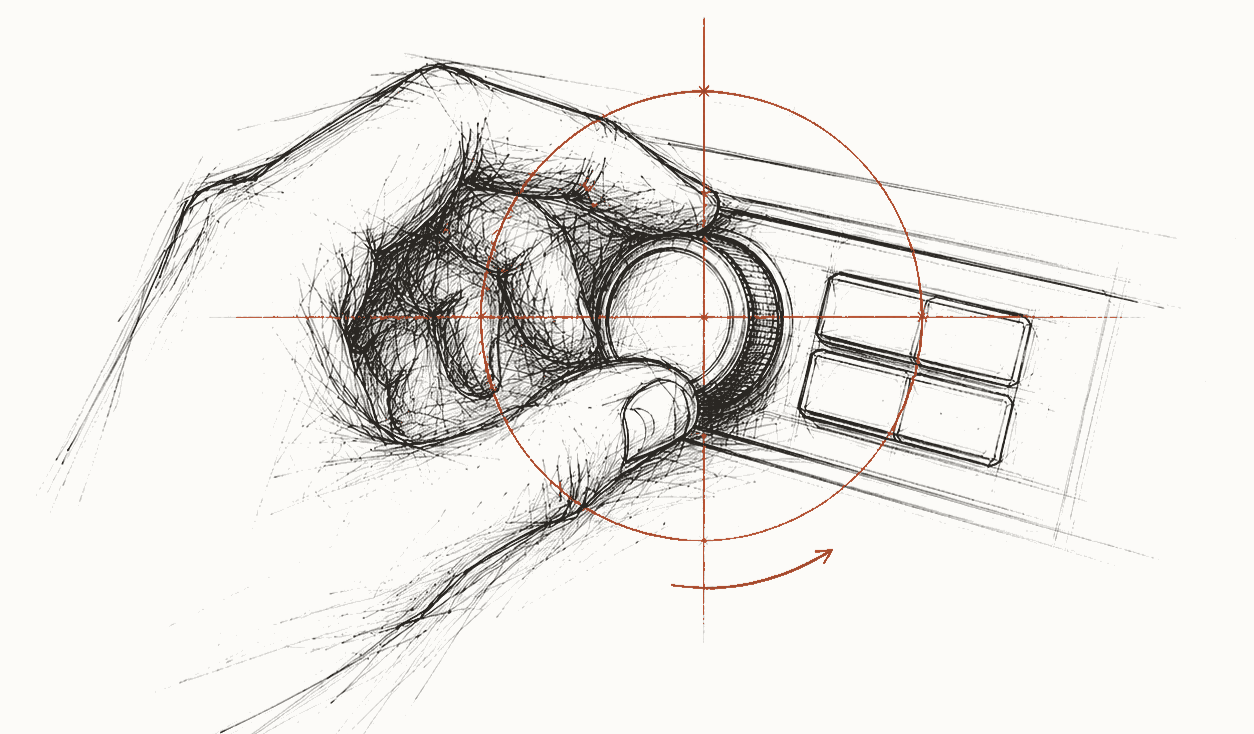
I am running late and on my way home. The motorway is clear, eighty-six kilometres straight ahead and I know the way in my sleep. An audiobook is playing, my thoughts have long since wandered elsewhere, to the conversation this afternoon, to dinner, to nothing in particular. My hands rest on the wheel and I could not tell you what they are doing. The car holds its lane, the distance is right, a lorry pulls past. Everything runs. And I am not really there at all.
You probably know this, the state in which the car almost drives itself and the mind is free for other things. Last week I wrote about how rarely we notice the constant work our brain does in the background. Driving is the finest example of it. Something in us carries out a difficult and dangerous task with complete reliability and we take in almost none of it.
Then it gets tighter. I come into the city, the traffic closes in, everything stalls at the lights, someone pushes in from the right. The audiobook plays on, but I no longer hear it, the words rush past without arriving. At some point I switch to music. And when I have to reverse into the narrow gap between two cars outside my door, I turn the music down. And then off entirely.
You have probably done this too, without thinking about it. But why, exactly? The radio does not block your view. The music does not make the space any tighter. And still it has to go, in that precise moment, for almost all of us.
The answer reveals something about how we think. In our heads two very different ways of thinking work side by side. The psychologist Daniel Kahneman made them widely known, fast thinking and slow thinking, System 1 and System 2 in the technical terms. System 1 is on duty almost all the time. It is quiet, it never strains and it does not feel like thinking at all, more like seeing or hearing, like something that simply happens. It is what we call, in everyday life, our intuition or our gut feeling. It keeps the car in its lane on the open motorway, it recognises the face of a friend in a crowd before you go looking for it, and when asked what twenty-three times seventeen comes to, it says without hesitation, oh, somewhere around four hundred.
To be that fast, System 1 takes shortcuts. Rather than think each situation through from the ground up, it falls back on rules of thumb, on what has served in similar situations before. Such rules of thumb are called heuristics and most of the time they are spot on. If we had to work out every action, every judgement, every conversation from scratch, we would never keep up with life. Fast thinking is not a flaw to be fixed. It is the very condition that lets us get through the day at all.
Sometimes, though, the rule of thumb is not enough. Then System 2 speaks up, the slow thinking. It actually works out twenty-three times seventeen and, after a few seconds, arrives at three hundred and ninety-one. It is more accurate, but it demands something we have only in limited supply, namely attention. And attention cannot be divided. Whatever System 2 puts into one thought is missing everywhere else. That is exactly what happens when you park. In the moment the slow thinking kicks in, there is nothing left for the audiobook, the music or the thoughts of the evening. That is why the radio goes off. It is not superstition. It is the one point of the drive at which I clearly feel what thinking costs me.
And now comes the part that troubles me. That feeling of effort, the one that makes me turn the radio off, is a warning light. It comes on when things get difficult, when a mistake would be costly, when I need to look more closely. Then I wake up. The problem is not the light. The problem is that there is none for the opposite case.
Because when System 1 handles something effortlessly, it stays silent. No resistance, no effort, nothing that speaks up. And it is precisely this silence that feels good. It feels like ease, like clarity, like the impression that the thing is simply right. But silence is not a warning. It seems to us like a statement about the world, when it is only one about us. It says merely that the answer came to us smoothly and without resistance. Whether the answer is right, the silence does not say. Ease and truth are two different things, and yet we confuse them all the time.
Once you start paying attention to it, you see how often you follow this ease. The person you believe you have summed up after five minutes. The figure you do not check because it looks the way you expected. The decision that wins the meeting because it makes immediate sense to everyone and no one objects. In all these moments we confuse how effortlessly something makes sense with the question of whether it is right. This is how cognitive biases arise, the systematic distortions in our judgement that affect all of us, even when we know about them. The smoother a judgement comes, the less we have tested it. And the more sure we feel about it.
With that the whole drive turns around. The dangerous part is not the tight gap. That feels hard, so I am awake, I turn the radio down, I check the mirrors. The difficulty sounds the warning all by itself. What is dangerous is the long, open kilometres before it, the ones that feel like nothing, familiar, driven a thousand times. There the radio stays on. There the mind wanders. There I drive on autopilot, and if something goes wrong there, I notice only when it is long since too late.
This is exactly why it is worth thinking about our own thinking. We assume as a matter of course that we think clearly, since we do it all day long. But the places where we feel most sure are often the very ones where no one is looking any more. There no feeling warns us, because nothing feels hard. Thinking more wisely does not mean straining even harder when things are already hard. It means pausing precisely when everything seems easy. Reflection is really nothing other than turning the radio down even though the road is clear.
So perhaps the most useful question at the end of a day is not where you made an effort. It is the quieter question, where something came too easily to you today.
For the week ahead
Watch yourself thinking this week, just once. Do not take the hard decisions, you supervise those consciously anyway. Take an easy one, one you are immediately sure about, and deliberately turn the radio down on it. Pause and give it five minutes, even if it seems not to need them. See what changes when you really look.
Three questions for the road.
When was I immediately sure this week, without thinking? (Did I judge a new person on instinct, or agree with someone without thinking it over?)
If I now look again, deliberately, was my first impression right?
And if not, what made me so sure?
Enjoy your thinking, and see you next week.
— Luc
-
Alter, A. L., & Oppenheimer, D. M. (2009). Uniting the tribes of fluency to form a metacognitive nation. Personality and Social Psychology Review, 13(3), 219–235.
Evans, J. St. B. T., & Stanovich, K. E. (2013). Dual-process theories of higher cognition: Advancing the debate. Perspectives on Psychological Science, 8(3), 223–241.
Kahneman, D. (2011). Thinking, fast and slow. Farrar, Straus and Giroux.
Thompson, V. A., Prowse Turner, J. A., & Pennycook, G. (2011). Intuition, reason, and metacognition. Cognitive Psychology, 63(3), 107–140.
Subscribe to my newsletter and get my essays straight to your inbox.
Reflection starts with dialogue.
If you’d like to share a thought or question, you can write to me at contact@lucalbrecht.com
Thinking from Scratch
by Luc Albrecht
Exploring how we think, decide and create clarity