Why brooding feels like thinking and yet settles nothing
The last few weeks were about noticing, how our own thinking deceives us and how sure that feels. But noticing is only the start. The real question is what we do with what we have noticed. So this time the step from seeing to understanding, and why the thing we take for understanding often costs us no more than a night's sleep.
„Dig within. Within is the wellspring of good, and it is always ready to bubble up, if you just dig.“
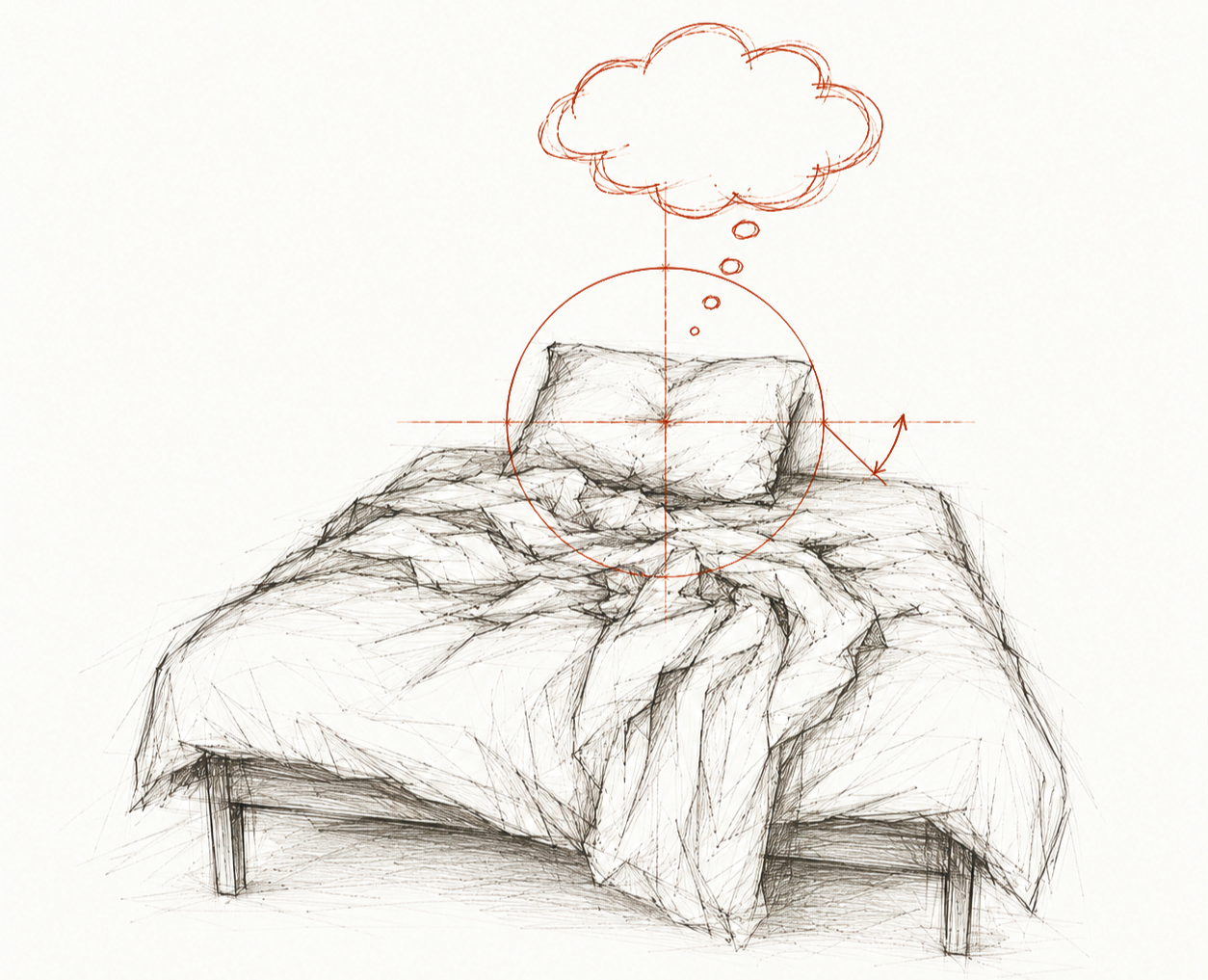
The loops in my head
It is just gone two, and I am wide awake. Not because anything bad has happened, but because too much is going through my head at once. The application that has to go out tomorrow. The call I have been putting off for three days. The meeting on Friday I still have to prepare for, and the article I still have to write. And running through all of it, the quiet voice telling me that this week I only sat at my desk and spent too little time with my wife. And now I lie there and sort. Or at least I believe I am sorting. In truth I lift each thread of thought, turn it over, put it back, reach for the next, and oh, the first is already back on top. It feels like preparation, yet by morning not a single thing is any more done than before, and I am wearier than I was the night before.
For a long time I took this for planning, at worst for a little worry. But planning should bring something to a close. It leads to a note, an order of things, a decision. This brings nothing to a close. It goes round. And there lies a difference I long failed to see. Not every thinking about one's own life is self-reflection. Most of what keeps us awake at night is brooding, and from the inside the two feel almost the same.
Psychology, though, separates them cleanly. Trapnell and Campbell showed in the late nineties that we look inward for two entirely different reasons. One is curiosity, a real interest in what it looks like inside oneself. This they called reflection. The other is the dull sense that something is wrong and must be switched off, like an alarm that will not stop. This is brooding, or in the technical term, rumination. From the outside the two look the same, a quiet person, turned inward. From the inside, though, they lead in opposite directions.
The difference is not how much one thinks, but where one looks while doing it. Brooding asks a question that has no answer, and mostly without our even putting it into words. How am I supposed to manage all this? Why does it never let up? Why can I not get on top of what others so plainly manage?
These questions sound like a problem one could solve (they always sound that way), but they aim at nothing in particular, they only hold the whole weight up in front of you at once. You can do it all night long without anything ever coming of it, because nothing is meant to. The circling is the point, and it keeps the worry moving so that it never settles.
It is worth asking why we circle our thoughts at all when it solves nothing. Part of the answer is an old finding. In 1927 the psychologist Bluma Zeigarnik had some hundred and sixty people work on small tasks and interrupted half of them in the middle. Afterwards most remembered the interrupted tasks markedly better than the finished ones, on average almost twice as well. What is unfinished stays active in the mind, what is done falls away. Open loops clamour louder than closed ones, and at night almost every loop is open. The other part, and it weighs more, is uncertainty. Brooding feels like doing something about it. As long as I hold the threads in my hand and go through them again and again, I have the sense of having the thing under control, of being prepared, of nothing slipping past me. That is the real reward. It is not a solution, but the promise of being ready for anything. That is why stopping feels like carelessness, and why the well-meant advice simply to stop thinking about it helps so little. You are not giving up a problem, you are seemingly giving up control. The price is high, because the circling keeps the body on alert. Heart rate and tension stay up, as though an action were coming that never arrives.
Reflection, though, turns the direction of the gaze. It does not take the whole weight, it takes a single point and asks something specific. What of all this really belongs to this night, and what have I only brought to bed with me? What is the one thing tomorrow that counts? And what can wait without the world coming to a halt?
And sometimes, a layer deeper. What is this really about?
This is not another why-question about myself, the kind that only spins on, but one that points at something particular and so allows an answer. Because often the list is not the problem at all. Beneath the appointments and the call lies the quieter worry that in among all of it there is no room left for the people I am supposedly doing it all for (myself included). The moment I name that, the circling stops. Not because the tasks are gone, but because I finally know what I am really turning over in my mind.
This shift of perspective is exactly what this series has been after from the start. Turning the radio down to notice one's own thinking was self-reflection all along, it simply had no name. And it shows something that surprises me again and again. Effort alone is worth nothing.
Brooding is hard work, it costs sleep and nerves, the slow thinking runs at full tilt half the night. But it runs in neutral, much effort and no road. Like a floored accelerator with no gear engaged. It is not the amount of thinking that brings clarity, but its direction.
For me this is more than a question of better sleep. In my work on Critical Thinking, self-reflection is the part that is underestimated most. We take Critical Thinking to be something aimed outward, at arguments, at claims, at other people's mistakes. But the hardest and most important object is one's own mind, and you can only look at it once you stop wanting to defend it and start listening to it instead. Brooding takes everything apart with no intention of putting it back together. Reflection, by contrast, asks what is actually going on here. The one circles, the other clears.
So perhaps the question is not whether I think about my life at night. At two in the morning I do plenty of that. The question is whether my thinking arrives anywhere or only stays in the same place. And whether, the next time I lie awake with the list running through my head, I find the one question that leads out of the circle.
For the week ahead
If you lie awake this week with everything unfinished running through your head at once, pause for a moment and take on not the whole of it but a single directed question. Not "how do I get all this done?", but "what of all this really belongs to this night, and what is this actually about?". Notice whether something settles the moment the question turns away from the whole load and points at a single spot.
Three questions for the road.
Am I brooding right now or reflecting? Am I holding it all up at once, or asking about a single point?
Which worry has been going round in circles for days without my ever naming it?
What is this really about for me, beneath the list?
In that spirit, have a good week, and see you next Thursday.
— Luc
-
Flavell, J. H. (1979). Metacognition and cognitive monitoring: A new area of cognitive–developmental inquiry. American Psychologist, 34(10), 906–911. https://doi.org/10.1037/0003-066X.34.10.906
Grant, A. M., Franklin, J., & Langford, P. (2002). The Self-Reflection and Insight Scale: A new measure of private self-consciousness. Social Behavior and Personality, 30(8), 821–835. https://doi.org/10.2224/sbp.2002.30.8.821
Trapnell, P. D., & Campbell, J. D. (1999). Private self-consciousness and the five-factor model of personality: Distinguishing rumination from reflection. Journal of Personality and Social Psychology, 76(2), 284–304. https://doi.org/10.1037/0022-3514.76.2.284
Zeigarnik, B. (1938). On finished and unfinished tasks. In W. D. Ellis (Ed.), A source book of Gestalt psychology (pp. 300–314). Kegan Paul, Trench, Trubner & Company. https://doi.org/10.1037/11496-025
Subscribe to my newsletter and get my essays straight to your inbox.
Reflection starts with dialogue.
If you’d like to share a thought or question, you can write to me at contact@lucalbrecht.com
Thinking from Scratch
by Luc Albrecht
Exploring how we think, decide and create clarity